Health AI and Brain Health
We develop intelligent, human-centred technologies to transform healthcare diagnostics and decision-making. Our research focuses on AI-driven solutions for brain health, neurodegenerative and mental disorders, and clinical efficiency, with a strong emphasis on international collaboration and real-world impact.
Using AI and biomarkers, we create non-invasive tools for early detection and monitoring of neurodegenerative and mental health conditions. Our work bridges the gap between digital health innovation and clinical deployment, enabling scalable, accessible care—especially for underserved communities.
By integrating AI, data science, and neuroscience, we aim to revolutionise healthcare through smarter diagnostics, remote monitoring, and intelligent decision support systems.
Core members: Sam Madanian, Hazel Abraham, Hamid Gholamhossein
Current students: Upeka De Silva, Nam Nguyen, Fredy Rojas, Juan Alamiro Berrios Moya, Weifan Zhao, Minh Quach, Phuong Dang, Hamid Rasouli Panah, Priyadarshini Natarajan, Yuan Gao
External collaborators: Professor Christian Poellabauer (Florida International University), Professor Sandra Schneider (Saint Mary's College), Assistant Professor John Templeton (University of South Florida)
Funding: We welcome collaboration with academic, clinical, and industry partners to co-create impactful solutions that enhance health equity and quality of life.
- 2024 and 2023 Health Research Council of New Zealand
- KiwiNet Emerging Inventor 2023
- Google Cloud Research Credits 2023
Our projects
Speech Analysis for Neurodegenerative Diseases and Brain Injuries
This project explores the growing role of digital biomarkers, particularly speech features, in clinical decision support for various health conditions. Speech production involves complex physiological processes, including respiration, phonation, articulation, and resonance, each relying on specific motor systems. Deficits in any of these systems can alter speech signal patterns, offering valuable insights into underlying health issues. By leveraging data science techniques, this project aims to enhance speech signal analysis within a structured framework, integrating clinical practice, speech science, and technology. The focus is on physical speech features, rather than content, to support early detection, differential diagnosis, and classification of neurodegenerative and mental health conditions. A proposed research framework, adapted from design science principles, guides future investigations, emphasising the importance of interdisciplinary collaboration and establishing robust methods for clinical application. Findings from our ongoing experiments demonstrate the potential of speech-based biomarkers, especially in distinguishing conditions such as concussions and neurodegenerative diseases. The ultimate aim is to advance speech analysis as a reliable tool for early diagnosis and personalised treatment in neurodegenerative and mental health care.
AI for Emotion Recognition and Mental Health
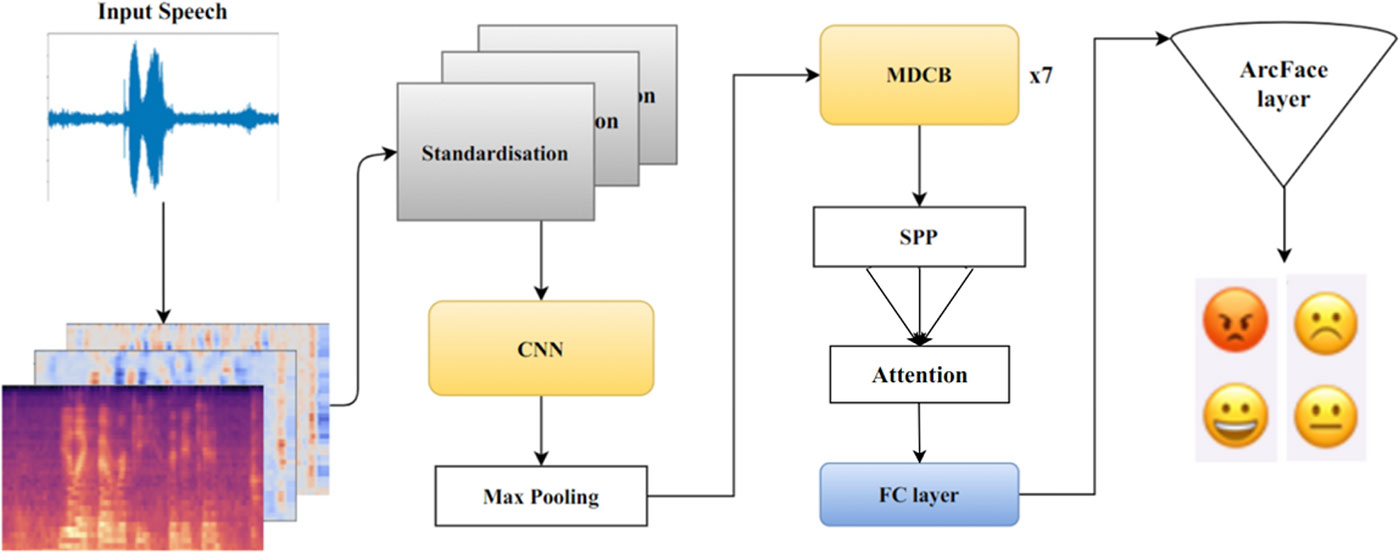
Human emotional states influence their utterances, which are produced through vocal cord vibrations. Accurate recognition of these emotional states encoded in speech signals is crucial and can be utilised for mental health applications. This includes aiding practitioners in assessments and decision-making, enhancing therapy effectiveness, monitoring patients, and supporting clinical training. Despite its importance, few studies focus on speech emotion recognition from a mental health perspective. Our preliminary research demonstrates the feasibility of automatic speech emotion recognition for mental health purposes, potentially marking the first step towards an intelligent support system for mental health care. This progress inspires further research in speech emotion recognition for mental health. Such systems could objectively detect emotions to assist practitioners in early diagnosis, assessment, and monitoring treatment responses, especially in cases where recognising patients’ emotions is vital.
IoT and Digital Twins for Healthcare Monitoring
This project focuses on leveraging the potential of technology integration, such as the Internet of Things (IoT) and AI, in building a Health Digital Twin to enhance healthcare monitoring systems. By integrating IoT devices such as wearable sensors and connected medical equipment with AI and digital twin models, the project aims to provide real-time patient data, predictive analytics, and personalised healthcare insights. The goal is to improve patient outcomes, enable proactive medical intervention, and streamline healthcare practices through innovative digital solutions.